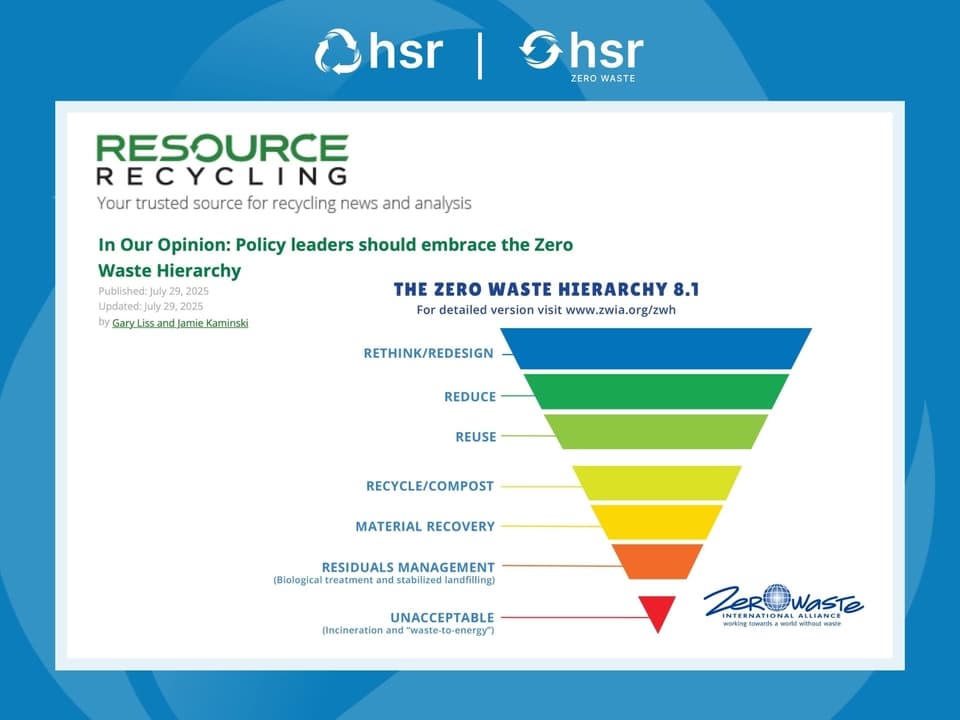
The recent op-ed co-authored by Jamie Kaminski, President of HSR Zero Waste, and Gary Liss, vice-chair of the Zero Waste International Alliance (ZWIA), in Resource Recycling magazine, brings to light the critical role of the Zero Waste Hierarchy in shaping sustainable waste management policies. Titled "In Our Opinion: Policy leaders should embrace the Zero Waste Hierarchy," the article serves as a pivotal call to action for policymakers to adopt this framework for more strategic environmental decisions.
The op-ed highlights the updated Zero Waste Hierarchy (Version 8.1), which introduces refined definitions, stronger ethical guidelines, and a renewed focus on prevention and equity. This version is the culmination of global insights from zero-waste leaders, aiming to foster systemic change towards a circular economy. Kaminski's contribution underscores the collective effort of the zero-waste community in advocating for policies that prioritize upstream prevention and sustainable resource management.
Resource Recycling magazine, a leading publication in North America, provides a platform for such discussions, amplifying the message that the Zero Waste Hierarchy is not just a tool but a necessary foundation for environmental policy. The article encourages readers to explore the full op-ed on the Resource Recycling website or to learn more about the Zero Waste Hierarchy at zwia.org.
This publication marks a significant moment for HSR Zero Waste and the broader zero-waste movement, as it seeks to influence policy leaders and institutions to embrace frameworks that ensure long-term environmental and economic benefits. The emphasis on prevention and equity within the Zero Waste Hierarchy reflects a growing consensus on the need for comprehensive strategies that address waste at its source, paving the way for a more sustainable future.
The updated hierarchy framework represents a critical evolution in waste management philosophy, shifting focus from traditional end-of-pipe solutions to proactive prevention measures. This approach acknowledges that the most effective environmental policies address waste generation before it occurs, rather than simply managing waste after creation. The ethical guidelines embedded in Version 8.1 ensure that equity considerations remain central to implementation, addressing potential disparities in how waste management policies affect different communities.
For policymakers, adopting the Zero Waste Hierarchy means moving beyond incremental improvements to embrace transformative change in resource management systems. The framework provides a clear roadmap for prioritizing actions that yield the greatest environmental benefits while minimizing negative impacts. By focusing on prevention first, communities can reduce the burden on landfills, decrease pollution, and conserve natural resources more effectively than through recycling or disposal-focused approaches alone.
The timing of this advocacy effort coincides with increasing global pressure to address waste management challenges comprehensively. As municipalities and nations grapple with growing waste streams and limited disposal capacity, the Zero Waste Hierarchy offers a scientifically-grounded approach that aligns with broader sustainability goals. The framework's emphasis on systemic change recognizes that isolated solutions cannot address the complex interplay of production, consumption, and disposal patterns that characterize modern waste challenges.